
Tax Clearance Certificates
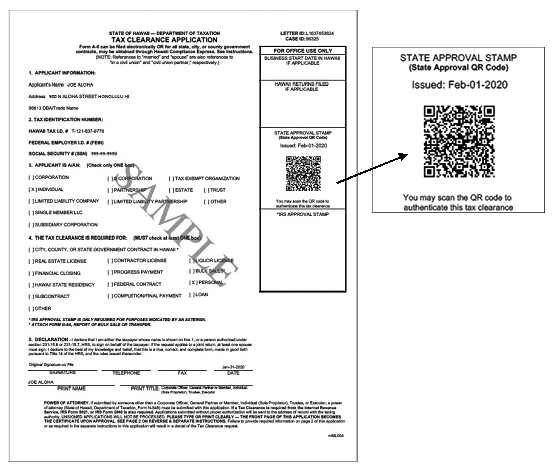
Tax clearance certificates issued prior to September 3, 2019, will have a green stamp with a signature. Tax clearance certificates issued after September 3, 2019, will have a scannable QR code that can be validated. This enables tax clearance certificates to be processed electronically and printed by the taxpayer. The QR code can be scanned using a web enabled device, such as a smart phone, to confirm authenticity and validity. A tax clearance certificate may be revoked by the Department when the taxpayer falls out of tax compliance.
FREQUENTLY ASKED QUESTIONS (FAQS)
How do I apply for a tax clearance certificate?
After signing in to your Hawaii Tax Online account, navigate to “I Want To” then to “Request a Tax Clearance Certificate” under “Tax Clearance.” You can also download and print the tax clearance application, Form A-6, and submit in person, by fax, or by mail. Mailing addresses and contact information are provided on page 2 of the application.
Can a Certificate of Vendor Compliance from Hawaii Compliance Express, vendors.ehawaii.gov/hce/, replace a tax clearance certificate?
How long is a tax clearance certificate valid?
The tax clearance certificate does not have a “valid period” or “expiration date.” Partners requiring the tax clearance certificate set their own rules regarding date of issuance.
Does it cost anything to request a tax clearance certificate?
No. Currently, there is no fee to submit an application for a tax clearance certificate.
Who can apply for a tax clearance certificate?
The individual taxpayer, a corporate officer, general partner or member, trustee or executor or an authorized agent with a valid Power of Attorney, Form N-848, may apply for a tax clearance. A tax clearance review can also be initialized by the Department of Taxation or a partner agency (e.g., Hawaii Compliance Express).
If I am on a payment plan, will I be able to obtain a tax clearance certificate?
Yes, if the full debt is in a valid payment plan, you will be considered compliant and will be issued a tax clearance certificate. If the payment plan is broken, the Department of Taxation reserves the right to invalidate the tax clearance certificate issued.
I submitted a tax clearance application, how long will it take to process?
In most cases, requests on Hawaii Tax Online are processed within one day. A paper Form A-6 may take 10 to 15 business days.
My tax clearance application was denied. What do I need to do?
Sign in to your Hawaii Tax Online account to view information about your tax accounts (navigate to “I Want To” then to “Manage Payments and Returns”). The tax clearance denial letter also provides you with any returns that need to be filed or outstanding liabilities that need to be paid. Once all of the returns are filed and payments made, submit a new tax clearance application.
Why am I receiving an email from HCE stating that my Department of Taxation A-6 Form has been changed from compliant to non-compliant?
If this notification was issued on a weekend or holiday, please check your compliance status on the next business day. If it was not received on a weekend or holiday, you can view information regarding your tax accounts on Hawaii Tax Online. Please refer to question regarding checking tax compliance status below.
Can I check my tax compliance status without applying for a tax clearance certificate?
Yes. Sign in to your Hawaii Tax Online account, navigate to “I Want To” then to “Tax Compliance Status” under “Tax Clearance.” If your status is “Compliant,” a tax clearance certificate would be issued if you applied for one. If your status if “Non-Compliant,” return to the home screen and navigate to “I Want To” then to “Manage Payments and Returns” for the list of returns and payments that must be submitted before a tax clearance certificate would be issued.
Does the Department of Taxation share tax clearance status with other agencies?
The Department of Taxation may enter into data sharing agreements to provide the tax clearance status to authorized government agencies or its vendors. It will not share details as to why the entity is not tax compliant.
For more FAQs, see:
Forms:
Related:
Page Last Updated: January 14, 2026